Biomarker Guide
LDL Cholesterol Explained: Healthy Ranges, Causes & How to Lower It
LDL cholesterol is one of the most-tested and most-misunderstood numbers on a routine lab panel. This guide explains what it really measures, what a healthy range looks like for you, and how VHT.ai's digital health twin makes the long-term trend actionable.
Part of Lipid panel (cholesterol test)

What is LDL cholesterol?
LDL (low-density lipoprotein) cholesterol carries cholesterol from the liver to cells throughout the body. It is often called "bad" cholesterol because, when levels stay elevated over time, LDL particles deposit cholesterol inside artery walls, forming plaque that narrows blood vessels and raises the long-term risk of heart attack and stroke. LDL itself is not poison — your body needs cholesterol to build cell membranes, hormones, and vitamin D — but the balance matters.
How LDL cholesterol is measured
LDL is reported in milligrams per deciliter (mg/dL) in the United States and millimoles per liter (mmol/L) in most other countries. A standard lipid panel measures total cholesterol, HDL, triglycerides, and either calculates or directly measures LDL. Most labs still use the Friedewald equation; a direct LDL test or an apolipoprotein B (ApoB) test is more accurate when triglycerides are high or LDL is very low.
What is a healthy LDL range?
For most healthy adults, an LDL under 100 mg/dL (2.6 mmol/L) is considered optimal. 100–129 is near optimal, 130–159 borderline high, 160–189 high, and 190+ very high. People who already have cardiovascular disease, diabetes, or genetic conditions like familial hypercholesterolemia generally target LDL under 70 mg/dL (1.8 mmol/L), and sometimes under 55 mg/dL with newer guidelines. Your specific target depends on your overall cardiovascular risk — your clinician should set it with you, not a generic chart.
Why a single LDL reading is not enough
LDL fluctuates with diet, alcohol, weight changes, recent illness, and even seasonal patterns. A single high or low result can be misleading. What matters far more is the trend over months and years, and how LDL moves alongside HDL, triglycerides, blood pressure, weight, activity, and inflammatory markers. This is exactly the kind of multi-signal pattern a digital health twin is built to surface.
Lifestyle changes that lower LDL
Reducing saturated fat (red meat, butter, full-fat dairy, tropical oils) and eliminating trans fats has the largest dietary impact. Adding soluble fiber (oats, beans, lentils, apples, psyllium), plant sterols, fatty fish, nuts, and olive oil consistently lowers LDL in randomized trials. Regular aerobic exercise, losing 5–10% of body weight if overweight, and stopping smoking all contribute. Lifestyle alone can move LDL by 10–30% for many people — meaningful but not always sufficient.
When medications come into play
Statins remain first-line therapy and reduce cardiovascular events even in people with only moderately elevated LDL when overall risk is high. Ezetimibe, bempedoic acid, PCSK9 inhibitors, and inclisiran are options when statins alone are insufficient, not tolerated, or contraindicated. The decision is never about LDL alone — it weighs your 10-year cardiovascular risk, family history, other conditions, and personal preference. A digital twin makes this conversation faster by putting the full picture in one place.
Family history and genetic LDL elevation
Familial hypercholesterolemia (FH) affects roughly 1 in 250 people and causes lifelong, very high LDL from birth. It dramatically raises early heart-attack risk but is highly treatable when caught. Red flags include LDL above 190 mg/dL in an adult or above 160 in a child, a parent or sibling with early heart disease (men under 55, women under 65), or tendon xanthomas. If any of these apply, ask your clinician about genetic screening.
Frequently asked questions
What is considered a dangerous LDL cholesterol level?
For an average-risk adult, an LDL above 190 mg/dL (4.9 mmol/L) is considered very high and is usually treated aggressively regardless of other factors. For people with existing heart disease, diabetes, or a strong family history, levels above 70–100 mg/dL may warrant treatment depending on overall risk.
Can I lower LDL cholesterol without medication?
Many people can lower LDL by 10–30% through diet (more soluble fiber and unsaturated fat, less saturated and trans fat), regular aerobic exercise, weight loss, and quitting smoking. Whether that is enough depends on your starting LDL and overall cardiovascular risk; some genetic conditions require medication regardless of lifestyle.
How often should I test my LDL cholesterol?
Healthy adults typically check a lipid panel every 4–6 years starting in their 20s, more often after age 40 or when risk factors are present. People on cholesterol medication or actively changing their lifestyle usually re-test every 3–12 months to track progress.
Is LDL the only cholesterol number that matters?
No. HDL ("good") cholesterol, triglycerides, non-HDL cholesterol, and apolipoprotein B (ApoB) each add important information. ApoB in particular reflects the total number of atherogenic particles and is increasingly favored over LDL alone for risk assessment.
How does VHT.ai track LDL cholesterol over time?
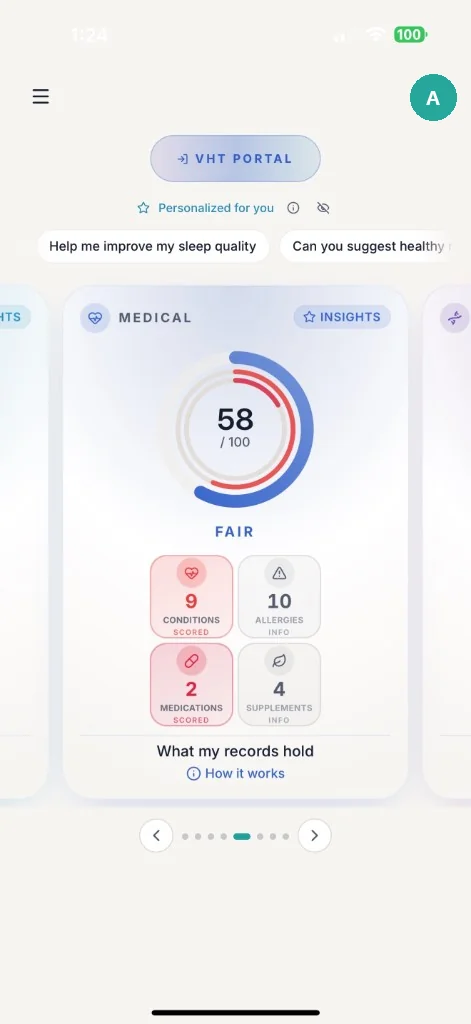
VHT.ai's digital twin imports lab results from your providers and Apple Health, then plots LDL alongside HDL, triglycerides, blood pressure, weight, activity, sleep, and medications. ECHNA, our clinical AI, flags meaningful trend changes — not noisy single-point spikes — and explains what is driving them in plain language.
Track your LDL trend in your digital twin
VHT.ai plots LDL alongside the rest of your health data and uses ECHNA to explain what is moving — not just what changed.